
Day 3 vs. Day 5 Embryo Transfers: Which Is Better?

Choosing when to transfer an embryo can feel like one more big decision during an already emotional time. After egg retrieval and fertilization, your embryos continue developing in the laboratory as your care team monitors their progress.
You may naturally wonder whether transferring an embryo on Day 3 or waiting until Day 5 gives you a better chance of success.
For patients with a good prognosis, research reviewed by the American Society for Reproductive Medicine (ASRM) suggests that Day 5 blastocyst transfer may result in higher live birth rates per fresh transfer than Day 3 cleavage-stage transfer. Waiting until Day 5 also gives the embryology team more time to observe how embryos develop before selecting an embryo for transfer or freezing.
However, not every embryo reaches the blastocyst stage, which is an important consideration when deciding when to transfer.
Understanding the differences between Day 3 and Day 5 transfer can help you feel more informed and confident as you move through your IVF journey.
A Question With No One-Size-Fits-All Answer
Neither Day 3 nor Day 5 is automatically the better choice for every patient. Your fertility team may consider:
- How many embryos are developing
- How your embryos are progressing in the laboratory
- Your age and overall prognosis
- Your previous IVF or embryo-development history
- Whether genetic testing is part of your treatment plan
- Your clinic’s laboratory experience and ability to support extended embryo culture
Keep reading to understand why your care team may recommend one approach over another. If you’re looking for more information about the steps involved in IVF treatment, review PRC’s resources or talk with your fertility specialist.
Understanding Embryo Development: Day 3 vs. Day 5
Once your egg is fertilized, the embryo continues developing over the next several days. PRC’s IVF timeline explains where these steps fit within the larger IVF process.
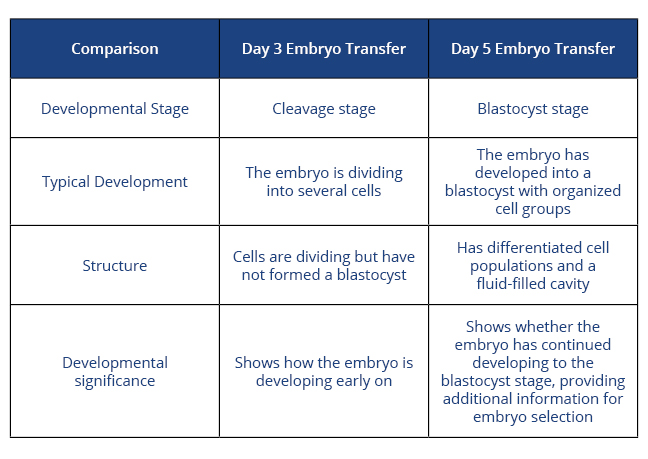
The biggest difference is how far the embryo has developed before transfer. A Day 3 embryo is transferred earlier, while a Day 5 blastocyst has had more time to develop in the laboratory.
What Is a Day 3 (Cleavage-Stage) Embryo?
A Day 3 embryo has developed for about three days after fertilization. It is usually in the cleavage stage, when the embryo is dividing into more cells.
A normally developing Day 3 embryo may have about six to eight cells.
At this point, the cells have not yet organized into the structures found in a blastocyst. If a Day 3 embryo is transferred, it continues developing after transfer. It must continue dividing, form a blastocyst and eventually implant in the uterine lining.
What Is a Day 5 (Blastocyst) Embryo?
A Day 5 embryo has developed for about five days after fertilization and has reached the blastocyst stage. Some embryos reach this stage on Day 6 or later.
A blastocyst has different groups of cells that have started to take on specific roles. The inner cell mass develops into the embryo, while the trophectoderm contributes to the placenta and other tissues that support pregnancy.
Because the embryo has had more time to develop, the embryology team has additional information to consider when selecting an embryo for transfer or freezing. However, not every embryo that is developing on Day 3 will reach the blastocyst stage.
Day 3 vs. Day 5 Success Rates: What the Research Shows
Success rates can look different depending on when an embryo is transferred and which patients are included in the research.
When comparing Day 3 and Day 5 transfers, it is important to consider both the potential benefits of extended embryo culture and the possibility that some embryos may not reach the blastocyst stage.
- Day 5 transfers may have higher live birth rates per fresh transfer for some patients
- Some embryos may stop developing before reaching the blastocyst stage
- The number and quality of your embryos can affect which approach makes sense
- The outcome of one fresh transfer does not tell the whole story of an IVF cycle
Blastocyst culture can give the embryology team more information when selecting embryos for transfer. However, extended culture requires the right laboratory equipment, protocols and trained embryology staff.
There is no single transfer day that is best for everyone. Your fertility team can help you understand which option may be best for you based on your embryos, treatment history and overall prognosis.
When Might a Day 5 Transfer Be Recommended?
Growing embryos to Day 5 gives your fertility team more time to see how they develop. This can provide additional information when deciding which embryo to transfer.
Your fertility team may consider a Day 5 transfer when:
- You have several embryos developing
- Your embryos are continuing to develop well
- Your care team believes extended culture may provide useful information for embryo selection
- You are planning to have PGT-A, which requires an embryo to reach the blastocyst stage
- Your treatment plan includes a single embryo transfer
Not every embryo will continue developing to Day 5. Your fertility team will consider how your embryos are developing and your overall treatment plan when deciding whether to continue growing them in the laboratory.
When Might a Day 3 Transfer Be Considered?
A Day 3 transfer allows an embryo to be transferred before it reaches the blastocyst stage. For some patients, this may be an option when there are concerns that an embryo may not continue developing in the laboratory.
Your fertility team may consider a Day 3 transfer when:
- You have only a few embryos developing
- You have concerns about whether your embryos will continue developing during extended culture
- You have had a previous IVF cycle in which few or no embryos reached the blastocyst stage
- Your care team believes transferring earlier may be a better option for your situation
Your fertility team may consider your embryos, treatment history and overall prognosis when deciding whether to transfer on Day 3 or continue embryo culture.
The Lab Environment Matters
The laboratory environment plays an essential role in supporting embryo development.
Embryology labs carefully control conditions that can affect embryos, including:
- Temperature: Embryos need a stable temperature during culture and handling
- Oxygen and carbon dioxide: These gases are carefully controlled inside incubators to create conditions that support embryo development
- Air quality: Labs monitor air quality and contaminants to help maintain a controlled environment
- Humidity: Humidity is controlled to help reduce contamination and prevent excess evaporation during embryo handling
- Equipment performance: Incubators and other laboratory equipment are regularly monitored, maintained and checked to make sure they are working properly
Modern IVF laboratories can also use real-time monitoring systems to track important conditions and alert laboratory staff when something falls outside an acceptable range. Regular equipment checks, calibration and maintenance help the embryology team identify problems quickly and maintain consistent conditions.
At Pacific Reproductive Center’s embryology lab, the laboratory team carefully manages the conditions used for embryo culture as part of the IVF process.
Frequently Asked Questions
Is a Day 5 blastocyst transfer always better than a Day 3 transfer?
No. Among patients with a good prognosis, Day 5 blastocyst transfer generally has a higher live birth rate per fresh transfer than Day 3 cleavage-stage transfer. However, extended culture also increases the possibility that no embryo will reach the blastocyst stage and be available for transfer. The best approach depends on your embryos, treatment history, prognosis and other factors.
How many Day 3 embryos reach the blastocyst stage?
There is no single percentage that applies to every IVF cycle. Blastocyst development can vary based on factors such as age, embryo characteristics and laboratory conditions.
The important point is that some embryos developing on Day 3 will not continue to the blastocyst stage. Your care team can explain what your embryo development may mean for your treatment options.
Can I request a Day 5 transfer if my clinic recommends Day 3?
Yes. You can ask your care team why they recommend one transfer day over the other.
Ask about:
- How many embryos are developing
- How your embryos are progressing
- Your previous IVF results
- Your chances of continued embryo development
- The potential benefits and risks of extended culture
Understanding the reasoning behind the recommendation can help you feel more confident in your treatment plan.
Does the Day 3 vs. Day 5 decision apply to frozen embryo transfers?
The Day 3 vs. Day 5 decision primarily concerns the stage at which an embryo is transferred or frozen during an IVF cycle. Embryos can be frozen at different stages of development, including the cleavage stage and blastocyst stage.
If you are considering a frozen embryo transfer (FET), your fertility team can explain which embryo stage and transfer approach is appropriate for your treatment plan.
How does PGT-A testing relate to embryo transfer timing?
PGT-A tests cells from an embryo for chromosome differences. With current PGT-A approaches, the biopsy is generally performed after an embryo reaches the blastocyst stage. This means embryos intended for PGT-A need to continue developing to that stage before the biopsy can be performed.
PGT-A is not automatically recommended for every patient. Your fertility specialist can help you understand whether PGT-A may be appropriate for your situation.
What Can You Do to Support Your Transfer?
Once you understand the difference between Day 3 and Day 5 transfer, you may also want to learn what you can do before and after your transfer to support your IVF journey.
Some factors are outside your control. You can, however, follow your care team’s instructions, take medications as prescribed and ask questions when you are unsure about any part of your treatment.
Personalized IVF Care at Pacific Reproductive Center
When you’re in the middle of IVF, it is natural to want to know which choice gives you the best chance—but the answer isn’t simply Day 3 or Day 5. Among patients with a good prognosis, Day 5 transfer generally has an advantage in live birth rate per fresh transfer. Still, the potential for embryo loss during extended culture is an important part of the decision.
At Pacific Reproductive Center, your care team considers your embryos, treatment history, prognosis and treatment goals when developing your IVF treatment plan.
If you have questions about your embryo transfer options, you can review PRC’s IVF success rates or schedule a consultation at one of PRC’s locations in Torrance, Glendale, Irvine or Corona.
Understanding why your fertility team recommends a particular transfer approach can help you feel more prepared for the next step.
This article is part of the educational content created by Pacific Reproductive Center to help patients understand fertility conditions, treatment options, and next steps. Our expert team has helped thousands of individuals and couples build families through evidence-based care, advanced reproductive technology, and experienced fertility specialists. Learn more about Pacific Reproductive Center, or review the full range of fertility treatments available at our clinics.